While play is vital for children, the kind of toys we give, especially when they’re very young, have a role in their development. A study has shown that block play is a foundation for literacy, and in this age where smartphones and gadgets dominate us, wooden blocks are very beneficial compared to staring at screens. What makes wooden blocks a valuable tool for a child’s learning experience?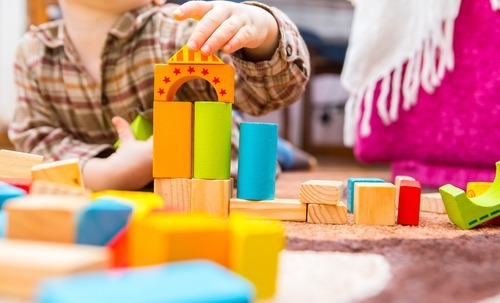
- Children learn concepts as the play progresses
- Toddlers Introduction to blocks will teach them how to hold the blocks, how to carry them, and how they feel. They learn to explore stacking blocks together, banging them together, and they can also learn about sizes and colors. When they can stack a pile of blocks without falling, they’ll feel proud and successful.
- Three-year-olds As this age goes into pretend play, they can use their imagination when building with blocks. They could pretend that a certain stack is a house, an enclosure as a zoo, or another pile as a tall tower. Whether they’re playing alone or with other children, they’ll be able to learn concepts in sorting and stacking, as well as shapes and sizes.
- Four to six-year-olds At these ages, block play is more complex and developed. There’ll be a better understanding of balance when stacking, various stacking patterns, and there can even be a sense for aesthetics when building blocks. There’s more room for creativity and imagination as they understand and play with more shapes and sizes, and as they share ideas with their playmates.
- Enhances fine motor skills and strength
Building blocks for kids help in fine motor skills because they need to figure out how to put blocks together so they won’t topple down. As they figure out how to carry the blocks and how to lift them as they stack, their strength is also being developed. Various shapes and sizes of building blocks also teach children how to grasp items appropriately so they won’t fall from their hands.
- Stimulates creative minds
Imagination is a human ability that we can develop and sharpen when we’re young. Wooden building blocks are a great tool to foster this skill as they build their fantasy world with the pieces they have. Basic shapes can be used variously as children explore creative ways to make certain structures.
- Encourages focus and patience
Compared to other toys, wooden blocks are less distracting because there’s no sound effects, lights, and mechanisms. Children can have a better focus on what they’re creating which stimulates their minds and thinking process. They will also become more patient as they figure out which strategies to use so the blocks won’t fall or to improve their designs.
- Reinforces social skills and interaction
Because wooden building blocks have no sound effects, it’s mostly their imagination at work. As they use their imagination to portray scenarios, they can bring others into play to get an interaction that they can’t get from building blocks. They’ll also learn from ideas shared by others and create something greater. Block play is one of the first forms of teamwork your child can participate in.
- Strengthens divergent problem-solving skills
Whilewooden puzzles can help in convergent problem-solving, building blocks encourage divergent problem-solving techniques because there’s no one way to create their designs. They will be prompted to think and act quickly before the building topples and find another way to re-adjust their creation.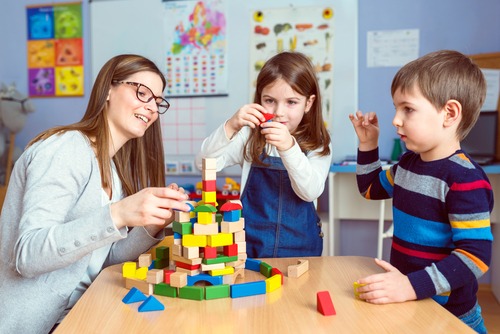
- Improves spatial awareness
Wooden block toys let children see the relation of objects to one another as they build. They can learn the foundations of being spatially aware to understand what it takes for a structure not to collapse. Depending on the design of the blocks, children could explore with trial and error which piece fits to which until they understand where specific shapes go.
- Increases tendency to perform better in mathematics at a later age
In line with spatial abilities, several studies have been conducted to take a look at the relation of block play performance to achievement in mathematics. Basic mathematical skills can also be exercised by counting blocks and making visual calculations of adding and subtracting blocks to achieve a particular structure.
- Enriches language development
It’s also possible for children to progress in language and vocabulary with block play. Because their creativity could turn blocks into various things, their ability to tell stories is also improved. As this kind of play encourages interaction with others and sharing of ideas, these can also contribute to language development.OverallWhen it comes to wooden building blocks it’s a great idea for children and their development. Are you thinking of buying some for your children?

I’m a 20-something stay-at-home mother and wife. I have an amazing husband, a beautiful daughter, two loving dogs, and a lazy cat. I wouldn’t change my life for anything! I love to read, listen to music, cook and blog!

Speak Your Mind