STEM activities, which incorporate Science, Technology, Engineering, and Mathematics, are certainly the most powerful ways to turn children’s learning experiences into fun and meaningful ones. These activities, which are a combination of experiments and projects, do not only provide academic knowledge but also the development of the skills of critical thinking, innovation, and teamwork.
Whatever your role is—instructor looking for fun class ideas or parents wanting to stimulate curiosity through home activities—STEM is suitable for children of all ages. Every single activity, from constructing simple machines to monitoring chemical reactions, permits the children to see and understand how the various phenomena work in the real world.
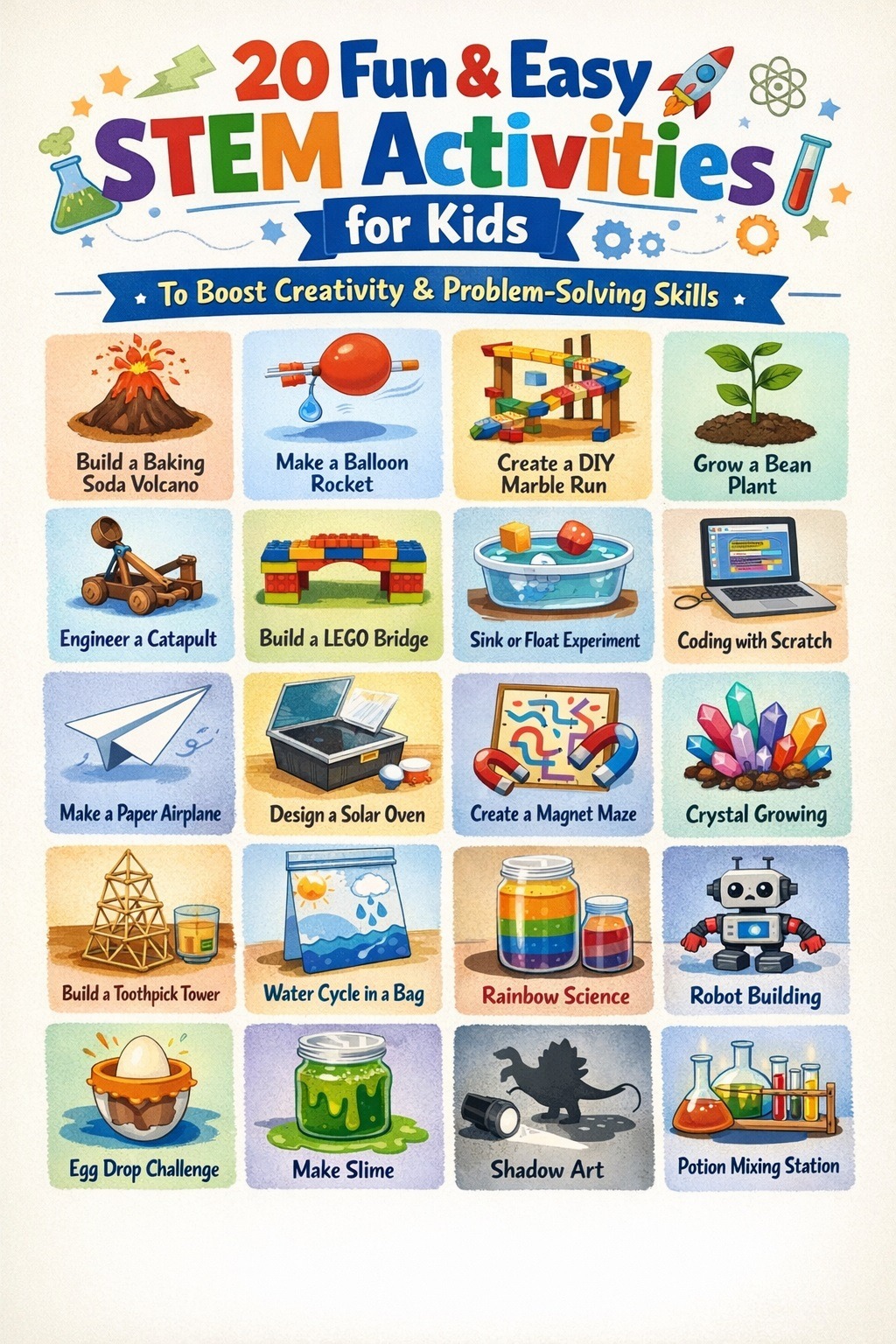
Here is a compilation of 20 simple yet exciting STEM activities that will not only be a means of developing the kids’ creativity but also the problem-solving skills of kids in a playful way.
Build a Mini Volcano
Kids are capable of making a miniature eruption with battlefield soda, vinegar, and dishwasher cleaning products. This experiment showcases chemical reactions and causes and effects in a most thrilling manner. The participants’ watching of the flowing lava will enable them to see the great force of the natural phenomena, and to comprehend the release of gas during the reactions.
Screen-Free Activities That Spark Imagination and Patience in Kids
Water Filtration Experiment
The kids can easily make a water filter using sand, gravel, and cotton. This activity will not only show them the need for clean water but also the working of filtration systems in real life.
Homemade Slime Experiment
Making slime is simply timeless! The kids will discover about the properties of polymers and viscosity in the course of mixing together glue, borax, (or saline solution), and water. Slime making is a very sensory filled experience that can be used to introduce young kids to the world of chemistry and material science.
Balloon-Powered Car
Children are capable of constructing cars with the help of recycled items and balloons. The deflating balloon moves the vehicle forward thus demonstrating the principle of propulsion and Newton’s Third Law of Motion in real life.
6 Fun Activities That’ll Entertain Your Kids Outside of School
Rainbow in a Jar
Mix different liquids like honey, dish soap and oil to get a beautiful rainbow in the jar. This activity elucidates the concept of density and how various substances interact depending on their molecular weight.
Build a Solar Oven
A box for pizza, foil, and plastic wrap are all the materials required for the kids to create a small solar oven to melt their chocolate or cheese. This very engaging demonstration of solar energy, heat reflection, and sustainability is done in a very practical way.
Static Electricity Experiment
A balloon rubbed on the head can do tricks like attracting small paper pieces or even making the hair stand on end. This experiment showing static electricity and electron transfer is made very simple and fun for children to grasp.
Homemade Compass
Children can conduct a magnetism experiment by making a needle magnetic through rubbing it with a magnet and floating it on water with a leaf or cork. The needle will show the direction of the magnetic north, thus revealing magnetism and its relation to navigation.
Plant Growth Observation
Let the children have the chance to sow seeds in transparent boxes to observe the root and shoot development connected over time. This remarkable experiment indeed brings the concepts of biology, photosynthesis, and environmentalism to life in very practical terms.
Top 7 Things To Do with Kids in Copehagen
Floating and Sinking Test
Consider collecting items from your home, such as spoons, sponges, and marbles, and letting the children predict whether each item will float or sink once it has been placed in the water. This will transfer the students into the realm of density, buoyancy, and even the very first steps of hypothesis testing.
Build a Mini Parachute
Beginners of an entertaining experiments series, the kids will learn about air resistance. The parachutes can be simply made by using plastic bags, string, and paper cups.
Egg Drop Challenge
Let the kids use straws, cotton, tape, and a raw egg. The challenge consists of constructing a protective structure capable of impeding the cracking of the egg when it falls. It imparts the principles of engineering design, gravity, and impact absorption to the participants.
Paper Bridge Challenge
Let the pupils use paper, tape, and books. The assignment is to build a bridge that is so strong that it can hold little things such as coins or toy cars. This activity will teach kids about the engineering design process, weight distribution, and also problem-solving as they will be allowed to do it through testing.
Marble Maze Game
The children design and build their labyrinth with the help of materials such as card boxes, straws, and marbles. It enhances their capability to think in three dimensions, develop logical reasoning, and be patient, as they have to get the marble from the starting point to the end.
Magnetic Treasure Hunt
Disperse paper clips, and coins, as well as screws across the room, afterwards each kid is given a magnet to pick them up. By means of this activity that is full of fun, the kids get to learn about magnetism and are also capable of identifying materials that are magnetic and non-magnetic.
Paper Airplane Contest
Children can create various types of paper airplanes and test which one flies the longest distance. That is a simple but very powerful way of showing the basic concepts of aerodynamics, symmetry, and the effect of wing design.
DIY Catapult
Kids can put together miniature catapults with the help of popsicle sticks, rubber bands, and spoons. Through this, they will learn the principles of potential and kinetic energy by altering the weights of the objects and finding out which one will fly the farthest.
LEGO Tower Challenge
Challenge the kids with a limited number of LEGO bricks to build the tallest and the most stable tower. This activity will develop the child’s imagination, and the ability to do the balancing act, and also teach them fine points in the construction of the building.
Sink-or-Float Boat Race
Children can bring their boats to life and compete in a race in the water-filled tub using materials such as foil, plastic bottles, or paper. This activity is interactive and gives kids a chance to understand the concepts of buoyancy, surface area, and drag practically.
Coding with Blocks
Offer kids to get acquainted with the fundamental coding through the free online resources like Scratch. By creating games or animations, they will not only be learning logic and problem-solving but also developing their creativity using technology.
Conclusion
STEM activities can be very inexpensive and easy to implement. The use of daily life and simple experimentation is the best context for learning moments to take place, and the users’ faith and imagination are also sparkled.
This time, we have put together a list of 20 projects that are not only fun and straightforward to do but also offer streams of inquiry, experimentation, and creation of their own solutions for kids. For instance, kids working with balloon cars develop their motor skills and at the same time through volcano making they are acquiring chemical skills.
Such activities create the foundation for acquiring the real-world skills of creativity, persistence, and logical reasoning. The organization of such activities allows teachers and parents to interact with various age groups thereby making STEM learning fun and easy for everyone.
We are turning the education process into a game that kids can play and through this, they will gradually acquire the confidence and creativity that will allow them to solve problems and think like real inventors in the future.

Hey welcome to my blog . I am a modern women who love to share any tips on lifestyle, health, travel. Hope you join me in this journey!


Speak Your Mind