CPR training is one of the few skills that can turn an ordinary bystander into the difference between someone going home to their family and someone not going home at all. Cardiac arrest does not announce itself. It happens in office pantries, on factory floors, at futsal courts, in shopping malls and inside homes — and in the vast majority of cases, it happens with no doctor in sight. What happens in the first four minutes, before the ambulance arrives, decides almost everything that follows.
This guide explains what CPR training actually involves, why it matters so much in the Malaysian context, what the law expects of employers, and how to choose a training provider that gives you skills you can genuinely rely on under pressure.
What Is CPR Training?
CPR stands for cardiopulmonary resuscitation. It is a manual technique that keeps oxygenated blood moving to the brain and vital organs when a person’s heart has stopped beating effectively.
CPR training teaches you to do three things quickly and correctly:
- Recognise cardiac arrest — knowing the difference between someone who has fainted, someone who is choking, and someone whose heart has genuinely stopped.
- Deliver high-quality chest compressions — at the right depth, the right rate, and with full chest recoil between compressions.
- Use an AED (Automated External Defibrillator) — the device that can actually restart a heart in a shockable rhythm.
The critical word is quality. Almost anyone can push on a chest. Compressions that are too shallow, too slow, or interrupted too often move very little blood. Proper CPR training exists to close the gap between “doing something” and “doing something that works.”
Why CPR Training Matters So Much in Malaysia
Out-of-hospital cardiac arrest remains one of the deadliest emergencies in the country, and survival rates in Malaysia are sobering — far below what is achieved in cities with strong bystander response cultures.
The reason is not a shortage of hospitals or paramedics. It is a shortage of trained people at the scene.
Consider the arithmetic:
- Brain cells begin to die within roughly 4 to 6 minutes without oxygenated blood flow.
- Survival chances fall by approximately 7 to 10 percent for every minute that passes without CPR or defibrillation.
- Ambulance response times in Malaysian urban areas — through traffic, into gated communities, up lift lobbies in high-rise buildings — routinely exceed 10 minutes.
Put those three facts together and the conclusion is unavoidable: by the time professional help arrives, the outcome has often already been determined. The person standing closest to the patient is the real first responder. CPR training is what prepares that person to act.
There is also a distinctly Malaysian complication. Cardiovascular disease has been the leading cause of death in the country for decades, and it strikes earlier here than in many comparable nations, driven by high rates of hypertension, diabetes and obesity. That means cardiac emergencies are not confined to elderly relatives. They happen to colleagues in their forties, to gym-goers, to men and women in the middle of a working day.
The Chain of Survival
Modern resuscitation is taught around a framework known as the Chain of Survival. Every link must hold:
1. Early recognition and call for help. Identify unresponsiveness and abnormal breathing, then call 999 immediately. Delay here costs more lives than poor technique ever will.
2. Early CPR. Immediate, high-quality chest compressions maintain circulation to the brain and buy time.
3. Early defibrillation. An AED analyses the heart rhythm and delivers a controlled shock when appropriate. Used within the first few minutes, it dramatically improves survival odds.
4. Advanced care. Paramedics and emergency physicians take over with medications and airway management.
5. Post-resuscitation care. Hospital treatment aimed at neurological recovery, not merely a restored pulse.
Links one through three belong entirely to bystanders. No hospital, however well equipped, can compensate for a broken first link.
What You Actually Learn in a CPR Training Course
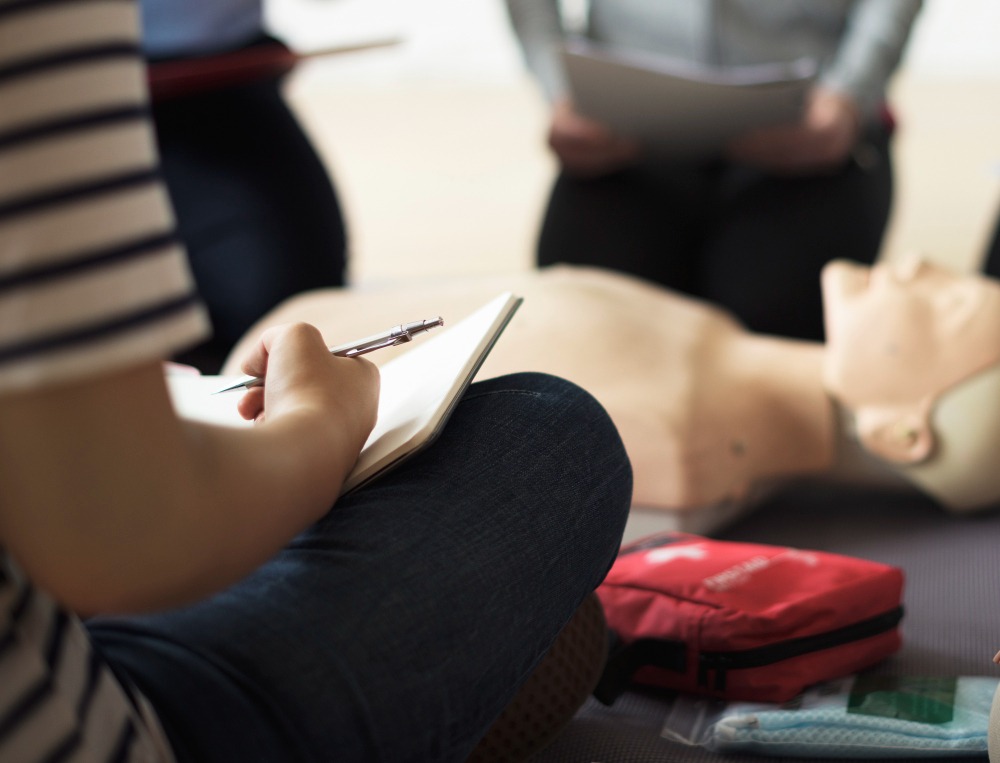
A properly structured CPR training programme is overwhelmingly practical. Expect to spend most of your time on a manikin, not in a chair. A quality course covers:
Scene safety and initial assessment
Checking for hazards before approaching, assessing responsiveness, and opening the airway using the head-tilt chin-lift manoeuvre.
Recognising agonal breathing
One of the most valuable lessons in any CPR course. Many cardiac arrest patients continue to make irregular, gasping noises for the first minutes. Untrained bystanders interpret this as breathing and do nothing. Trained responders recognise it for what it is and begin compressions.
High-quality chest compressions
Correct hand placement on the lower half of the sternum, a compression depth of roughly 5–6 cm in adults, a rate of 100–120 compressions per minute, and complete chest recoil. Feedback manikins make it possible to feel the difference between adequate and inadequate compressions.
Rescue breaths and compression-to-ventilation ratios
The standard 30:2 ratio for adults, along with proper mask technique and the reasoning behind compression-only CPR for untrained or unwilling responders.
AED operation
Powering on the unit, correct pad placement, ensuring nobody is touching the patient during analysis and shock delivery, and resuming compressions immediately afterwards.
Paediatric and infant CPR
Technique differs meaningfully for children and infants — two fingers or two thumbs rather than two hands, shallower compression depth, and a different likely cause of arrest (respiratory rather than cardiac). Parents, teachers, childcare staff and paediatric nurses should insist on this module.
Choking management
Abdominal thrusts for adults and children, back blows for infants, and the transition to CPR when a choking victim becomes unresponsive.
Team dynamics and rotation
Compressions degrade badly after about two minutes as the rescuer tires. Learning to rotate cleanly with minimal interruption is a skill in itself.
CPR Training and Malaysian Workplace Law
For employers, CPR training is not simply good corporate citizenship — it sits within a broader legal duty.
The Occupational Safety and Health Act 1994, significantly expanded by the 2022 amendment, requires employers to provide and maintain a working environment that is safe and without risk to health, so far as is practicable. The Act’s coverage was widened to encompass virtually all workplaces in Malaysia, not merely the industries originally scheduled.
Under DOSH guidance on occupational safety and health at the workplace, employers are expected to ensure that adequately trained first aiders are available, that first aid facilities are maintained, and that emergency response arrangements are documented and practised. The number of trained first aiders required scales with headcount and hazard level.
In practical terms, this means:
- Manufacturing and construction sites face the highest expectations, given machinery, height and electrical hazards.
- Offices are not exempt. Sudden cardiac arrest does not require a hazardous environment.
- Schools, gyms, hotels and shopping centres carry a duty of care to visitors as well as staff.
Beyond compliance, there is a straightforward commercial argument. Emergency response capability features in client audits, ISO 45001 certification, tender prequalification and insurance assessments. Increasingly, multinational clients simply ask how many certified first aiders you employ.
Is CPR Training HRD Corp Claimable?
For Malaysian employers registered with HRD Corp (formerly PSMB), CPR and first aid training delivered by a registered training provider is generally claimable against your levy contributions. This matters more than most companies realise — levy funds that go unclaimed are, in effect, money already spent with nothing to show for it.
When budgeting, confirm three things with your provider:
- That they hold current HRD Corp registration.
- That the specific course you want is on their claimable programme list.
- Whether they will assist with grant application and claim submission, which saves your HR team considerable administrative work.
How to Choose a CPR Training Provider
Not all certificates carry the same weight. When evaluating providers, look past the price and check the following.
Accreditation and curriculum lineage
Ask which international body’s curriculum the course follows. Programmes aligned with recognised standards — such as those accredited by ECSI (Emergency Care & Safety Institute) and the American Academy of Orthopaedic Surgeons (AAOS), with endorsement from the American College of Emergency Physicians (ACEP) — reflect current international resuscitation guidelines rather than locally improvised content.
Instructor-to-manikin ratio
This is the single most reliable indicator of course quality. If twenty participants share four manikins, hands-on time collapses. Aim for small groups with generous equipment.
Real AED trainers
Some providers describe AED use verbally or with a laminated diagram. Insist on physical AED trainer units so participants handle pads, hear the voice prompts and practise the pause-and-shock sequence.
Practical assessment
A course that ends without a skills assessment has tested nothing. Competent providers assess each participant individually.
Certificate validity and recognition
Most internationally recognised CPR and AED certifications remain valid for two years. Confirm that certificates are traceable, verifiable, and accepted by your industry regulator or auditor.
On-site delivery capability
For companies training an entire department, on-site delivery eliminates travel time and lets scenarios be run in your actual workplace — your production floor, your lift lobby, your site office.
Common Myths That Cost Lives
“I might break their ribs.” Rib fractures occur in a meaningful proportion of properly performed adult CPR. They heal. Cardiac arrest, untreated, does not. Fear of causing injury is not a reason to withhold compressions from someone whose heart has stopped.
“I could be sued if it goes wrong.” Reluctance to help stems largely from misunderstanding. A bystander acting in good faith within the scope of their training, without expectation of reward, is acting reasonably. The far greater risk — moral and practical — lies in standing by and doing nothing.
“I’ll just wait for the ambulance.” Every minute of waiting reduces survival probability substantially. CPR is what preserves the patient until the ambulance can do its job.
“I watched a video once, that’s enough.” Video familiarises. It does not build muscle memory. Compression depth, in particular, cannot be learned without feeling resistance under your hands. Nearly everyone who has only watched a video compresses far too shallowly on their first attempt.
“AEDs are complicated and only for medical staff.” Modern AEDs are deliberately designed for untrained users. They speak instructions aloud and will not deliver a shock unless the rhythm warrants it. They are, by design, difficult to misuse.
Frequently Asked Questions
How long does CPR training take? A focused CPR and AED course typically runs half a day to a full day. Combined first aid, CPR and AED programmes generally run one to two days.
How often should I renew my certification? Every two years is standard. Skills degrade measurably within months, so many organisations run short refresher drills between formal recertifications.
Do I need a medical background? No. These courses are designed for members of the public — office staff, teachers, security personnel, parents, gym trainers and site supervisors.
Should I do compression-only CPR or include rescue breaths? If you are untrained or unwilling to give rescue breaths, compression-only CPR is strongly preferable to no CPR at all. Trained responders should use the full 30:2 cycle, particularly for children, drowning victims and suspected drug overdoses, where oxygen depletion is the underlying problem.
Can CPR training be conducted at our own premises? Yes. On-site corporate training is common and often preferable, since scenarios can be rehearsed in the environment where a real emergency would occur.
Train Before You Need It
Nobody schedules a cardiac arrest. The value of CPR training lies entirely in having done it before the moment arrives — because in that moment, you will not have time to look anything up, and hesitation is the one thing you cannot afford.
CERT Academy has been delivering first aid, CPR, AED and occupational safety and health training in Malaysia since 2013. As an HRD Corp registered training provider accredited by ECSI and the American Academy of Orthopaedic Surgeons, with endorsement from the American College of Emergency Physicians, the academy has trained more than 400,000 individuals across over 6,000 corporate organisations. Training is delivered from the headquarters in Puchong, Selangor, from a second centre in Johor Bahru, and on-site at client premises nationwide.
Whether you are meeting an OSH compliance requirement, preparing your team for an audit, or simply want to be the person who knows what to do, the right time to learn is now.

Hey welcome to my blog . I am a modern women who love to share any tips on lifestyle, health, travel. Hope you join me in this journey!


Speak Your Mind