The Shifting Baseline of Infant Care
When preparing a nursery, expectant parents typically imagine quiet evening routines interrupted only by scheduled nighttime feedings. In practice, early childhood development progresses in rapid, non-linear phases. Within the first two years of life, a child transitions from an immobile newborn reliant entirely on caregiver presence to an agile toddler navigating room boundaries independently. Because parental concerns shift alongside these motor and behavioral milestones, the role of nursery monitoring rarely remains static. Understanding this trajectory helps families distinguish between temporary newborn anxieties and long-term hardware utility.
The Fourth Trimester: Immediate Proximity and Subtle Cues
During the initial months, infant sleep patterns are governed by short ultradian cycles rather than predictable circadian rhythms. The American Academy of Pediatrics recommends room-sharing without bed-sharing for at least the first six months to facilitate feeding and reduce sleep-related risks. In this phase, caregiver attention typically centers on subtle movements, normal breathing sounds, and early hunger cues before distress escalates.
A dedicated baby monitor for newborns generally serves as an acoustic and visual bridge during brief daytime separations or early evening naps before parents head to bed. In these early weeks, caregivers place high value on nuanced sensory feedback: distinguishing between quiet sleep grunts and active waking, or verifying subtle chest movement without physically walking across the nursery floor and inadvertently waking a light sleeper.
The Active Infant: Rolling, Repositioning, and Visual Clarity
Between four and nine months, infants develop significant gross motor skills. Rolling from back to stomach, pushing up on miniature arms, and shifting toward the corners of the crib become standard nighttime behavior. While pediatric safe-sleep guidance advises placing infants on their backs for every sleep period, babies who can turn over independently often adopt belly or side positions on their own.
This transitional stage transforms parental observation priorities. Instead of merely listening for soft vocal cues, parents find themselves checking crib posture. Everyday concerns focus on whether a sleeping position may cover the face against bedding or whether an arm has slipped between crib slats. Consequently, clear low-light visibility becomes essential. Optical sensors paired with invisible infrared night vision—specifically around 940nm wavelengths that emit no distracting red glare—allow parents to inspect resting positions clearly without disturbing infant sleep cycles.
The Toddler Transition: Mobility, Independence, and Expanding Boundaries
Once children cross the twelve- to eighteen-month threshold, bedtime challenges look entirely different. Motor development gives way to exploratory behavior. Toddlers learn to climb, transition from enclosed cribs to open toddler beds or floor mattresses, and experiment with bedtime boundaries. Night waking during this stage is rarely about basic physiological distress; it is more often linked to wandering, floor play, or developmental separation anxiety.
As children become more mobile and independent, nursery monitoring priorities naturally extend beyond the sleeping area to encompass the broader bedroom environment. Caregivers need a wider visual field to observe whether a child has slipped out of bed to explore the room, played quietly with toys, or approached closed doors. At this stage, monitoring supports overall bedroom safety rather than sleep posture checks, helping parents maintain situational awareness as a child practices self-soothing and bedtime independence.
Understanding Nursery Technology: Hardware, Sensing, and Practical Utility
Nursery monitoring has advanced considerably from the crackling analog audio transmitters of past decades. Modern systems blend high-resolution visual feeds, environmental sensors, and movement tracking. However, with numerous technical terms on packaging, having key baby monitor features explained helps parents separate genuine utility from unnecessary complexity.
Historically, tracking movement patterns required wearable hardware—such as specialized smart socks, chest bands, or clip-on tags. While functional for small infants, wearables introduce distinct friction points over time: infant skin sensitivity, rapid foot growth requiring frequent size changes, and older infants actively pulling bands off before bed. Consequently, modern design has shifted toward contact-free monitoring architectures. By utilizing non-invasive methods like high-frequency millimeter-wave (mmWave) sensing alongside computer vision, contemporary setups can observe subtle breathing dynamics and face coverage alerts completely detached from the child’s body.
Case in Point: Designing Across Developmental Milestones
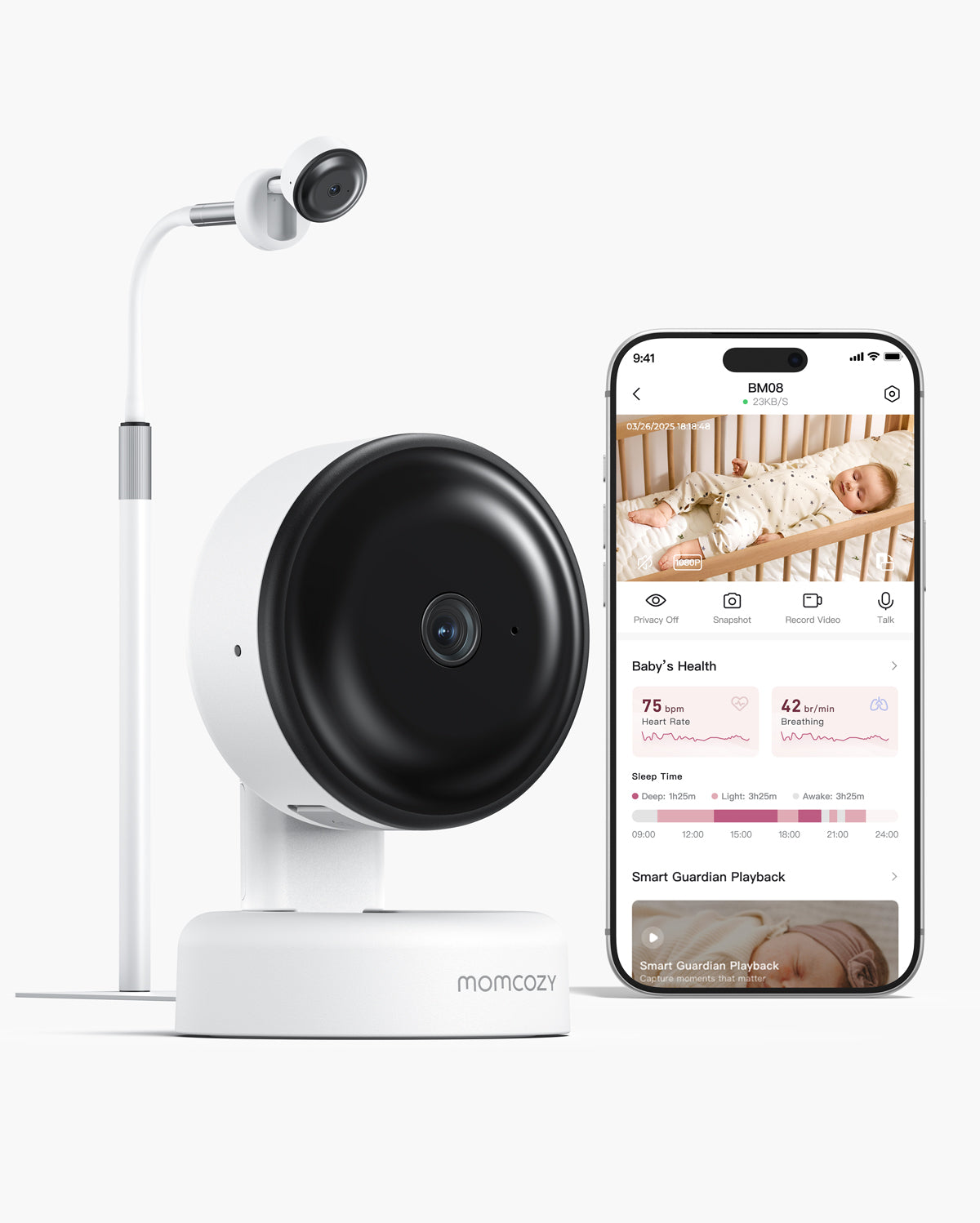
Bridging these diverse developmental phases requires hardware that accommodates growing children without requiring physical attachments or frequent replacements. An illustration of this design approach appears in the Momcozy Baby Monitor(BM08). Rather than relying on wearable accessories that toddlers easily discard, the system integrates contact-free mmWave sensing technology to monitor subtle breathing dynamics directly from above the sleep space.
Because sleep positioning becomes dynamic as babies learn to roll, the device incorporates 2K video clarity alongside automated notifications when a sleeping position may cover the face. Rather than depending on a dedicated handheld screen with restricted local range, it functions as an app-based monitoring system supported. This provides connection flexibility across home networks, allowing parents to review sleep insights or check live video from any room without carrying an extra proprietary screen.
Balancing Environmental Support With Parental Confidence
While digital tools provide helpful contextual awareness, thoughtful room preparation remains the cornerstone of pediatric sleep safety. A firm sleep surface, a bare sleeping space free of loose items, secured furniture, and consistent room temperatures form the baseline recommended by child safety professionals.
Nursery technology operates best when treated as background support rather than a substitute for parental judgment. As infants grow into curious toddlers, monitoring priorities naturally evolve from close tracking of physical movement to broad oversight of room safety and nighttime independence. Selecting equipment designed to support this all spectrum allows families to maintain quiet peace of mind through every developmental transition.

Hey welcome to my blog . I am a modern women who love to share any tips on lifestyle, health, travel. Hope you join me in this journey!


Speak Your Mind