Hadrian’s Wall Path, which is 84 miles long, is one of the leading things to visit and tackle while in Newcastle. It is important to note that the path passes through the city center. This means that it can be easy for you to pick up from the town and follow Hadrian’s Wall across some of the most beautiful countryside England has to offer.
Well, for more fun sightseeing ideas in Newcastle, go through our list of top tourist attractions in Newcastle upon Tyne.
1. The Millennium Bridge
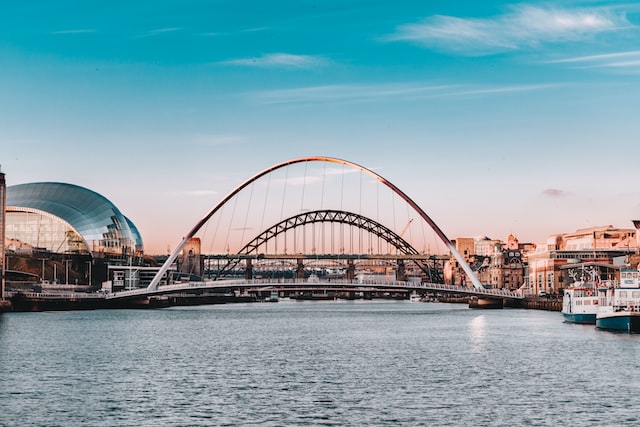
Taking a stroll (or riding a bike) along (or crossing the River Tyne) through the Gateshead Millennium Bridge will open your eyes to one of the spectacular buildings in Newcastle. The best thing about it all is that it will not cost you anything; it is free. The bridge was opened to the public back in 2001, and it stretches a distance of 126 meters across the river. It connects the Quayside areas of Newcastle with the trendy sides of the South bank.
The Millennium Bridge’s design has led to it being nicknamed The Winking Eye Bridge, which tilts enough to allow boat traffic to pass underneath it. It is quite a sight when it is tilting to allow boat traffic to pass through. It happens so often that you can easily catch it in action. You can also view Newcastle Adventure’s official website for scheduled tilt times. If you are staying in Newcastle for a longer period, do not forget to visit it at night and also explore Newcastle hotel deals.
2. The Historic Tyne Bridges
Do you know that, currently, there are seven bridges spanning the River Tyne in Newcastle? Three out of the seven are famous due to the revolutionary approach to bridge building. The High-Level Bridge is the oldest, and it is a two-level structure that is about 165 feet high. Its construction and plans went according to Robert Stephenson Architecture in 1849, and after completion, it was opened by Queen Victoria.
The second oldest bridge is the Swing Bridge, which was designed by Sir W. G. Armstrong and later opened to the public in 1876. Remember, the bridge stands on the same site where the Pons Aeliys’ fort was built by the Romans.
The third bridge, and the one that symbolizes the city’s identity, is known as the Tyne Bridge. Its construction began in 1925 and was opened by King George V in 1928. At that time, it was the only bridge with the largest arch in the world.
3. Newcastle’s Castles
One of the castles that bears testimony to how the city began is the Norman fortified tower. It is a well-preserved structure located north of Newcastle’s High-Level Bridge on St. Nicholas Street. Its construction began in 1080 and was completed in 1172. As you explore the castle, the late Norman Chapel and the king’s chambers can be visited. You will get to see many old passages and medieval chambers. You will also get to see a lot of fascinating medieval archaeological artifacts. The towers offer excellent views of the city.
The Black Gate (the gatehouse) was built in 1247 and is a place to explore, although it is separated by a train line. Guided tours allow you to visit both structures. For a better experience, consider planning a visit when one of the castles offers fun-themed seasonal events.
4. The Historic Quayside District
The Quayside district has been redeveloped and many of the old houses are currently restaurants, shops, and hotels. On Sandhill, you can visibly see several historic buildings, including the Merchants’ Court and Guildhall, which were built in 1658. Bessie Surtees House has been restored to consist of two merchant’s houses that date from the 16th and 17th centuries.
The Victoria Tunnel is a 2.5-mile-long, attractive underground tourist attraction. This tunnel runs beneath the city from Tyne to Town Moor Down. The tunnel was opened in 1842 as a wagonway for transporting coal from the colliery to the river. Large sections of the tunnel can be visited and seen by tourists.
5. Newcastle Cathedral
The cathedral was built back in the 14th and 15th centuries, and it is officially known as The Cathedral Church of St. Nicholas. It is not large because it was turned from a parish church into a cathedral back in 1882. However, it offers striking features such as lantern towers. Its height is almost 197 feet tall, and it was built in 1435. It is topped by a lovely crenellated Scottish Crown.
Its interior highlights include its organ, installed in 1676, canopied fonts and lectern that date to 1500, and many fine statues dating from the 15th to the 20th centuries. The cathedral is also home to an attractive caf located within its premises. Sir Alfred Gilbert built the statue of Queen Victoria in St. Nicholas Square in 1900. The best thing about visiting the cathedral is that it is free to all.

Hey welcome to my blog . I am a modern women who love to share any tips on lifestyle, health, travel. Hope you join me in this journey!


Speak Your Mind