A peek into Sequential screening tests & why are they important!

As a first-time mom, you definitely have a lot of queries like how to take care of yourself, what to eat, what various tests mean, what is beta hCG, and what does various hCG levels mean, first trimester screening, PAPP-A tests and more.
One such important tests are the sequential screening tests. As the heading goes, it’s a combination of tests done in your first and second trimester to check for any anomalies in the fetus, that could result in genetic defects or abnormalities at birth.
This article will help you understand more about the sequential screening tests along with some FAQs.
What tests are included in sequential screening and their importance?
The sequential screening tests, consists primarily of the following 2 blood tests and an Ultrasound:
Included in First trimester screening – Blood test 1: This test is conducted between weeks 11 and 13 of your pregnancy. It’s a test which measures the levels of pregnancy associated plasma protein A in your blood also known as the PAPP-A. Lower than normal levels of PAPP-A observed your first trimester can be associated with the risk of neural tube defects – like spina bifida.
Included in Second trimester screening – Blood test 2: This blood tests are conducted between 15 and 18 weeks of your pregnancy. Sometimes performed as late as 21 weeks as well.
These blood tests help diagnose the following:
- Alpha-Fetoprotein (AFP) levels: It is a protein secreted by your baby’s liver that can be detected in your bloodstream.
Very low or high levels of AFP could be correlated to birth defects.
- Estriol (uE3) levels: Estriol hormone is detected in highest quantity in a pregnant woman’s blood.
If its levels are low, then the baby could be at an increased risk of being born with trisomy 18 or Down syndrome.
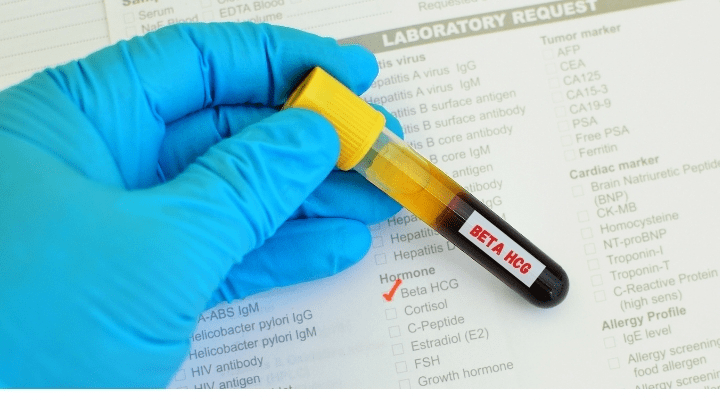
- Beta-hCG: This is secreted by the placenta into your body.
If the levels of hCG are lower in your second trimester are lower than normal then it indicates a higher risk of trisomy 18 and higher than normal levels indicate a risk of Down syndrome.
- Inhibin: Scientifically the exact role of this protein in pregnancy is yet to be understood. However, testing for this protein helps increase the accuracy of sequential screening.
Similar to hCG levels, higher levels of inhibin indicates a higher risk to Down syndrome, and lower than normal levels indicates risk of trisomy 18.
Ultrasound
Sequential screening includes the ultrasound done in your first trimester screening also called as nuchal translucency.
It is generally conducted between 11 to 13 weeks of your pregnancy.
Basically, nuchal translucency helps the doctors check the nuchal translucency back of your baby’s neck, which generally gets filled with fluid. The size of the back of your the child’s neck can be an indicator for genetic abnormalities like Down syndrome.
However, this may not be a definite diagnosis of abnormalities, still it does help support in conjunction with a few blood to tests to provide for a more accurate assessment of these genetic abnormalities.
For more details on the sequential screening test you can refer to a detailed article on www.parentingnmore.com which talks about how it’s done and further explains how to interpret the reports on
Sequential Screening some FAQs:
Are the sequential screening tests same for all pregnant women, or only for those having high-risk pregnancies?
Sequential screening tests form a part of Prenatal testing during pregnancy. These can be offered to all pregnant women.
Generally, in the First Trimester screening itself already has a few of the tests which form a part of the sequential screening tests � like nuchal translucency ultra sound. You can include other blood tests which form a part of sequential screening. Your doctor may or may not recommend the sequential screening tests of the second trimester basis the results of the first trimester screening.
To further answer your question, yes sequential screening is a crucial test which you should not avoid if yours is known to be having a high-risk pregnancy. This may be recommended more strongly for women that have a higher risk having a child with birth defects; like women over 35, those who have a family history of children with birth defects, Women exposed to high level radiation, women with diabetes, and women who have been taking a certain type of medication.
How & when is the sequential screening tests performed?
As mentioned in the article, sequential screening tests combines a few Blood tests and an ultrasound included in your first trimester screening � the nuchal translucency.
It is a combination of two blood tests and a first trimester ultrasound which helps your doctor understand more about your growing baby.
To put simply, the Part 1 of the test can be performed between 11 to 13 weeks of your pregnancy � Blood tests + ultrasound. And the Part 2 � Blood tests are done between 16-18 weeks of your pregnancy.
The final risk assessment combines the results gained from part 1 and part 2.
How accurate are the sequential screening tests?
In the Part 1 of the tests mentioned above the rate for detection of baby with down syndrome of trisomy 18 is about 80%. for
The Part 2 i.e. the last sequential screening test has a detection rate of approximately 90% for Trisomy 18 and 80% for Down syndrome and open neural tube defects.
Further for your knowledge the serum integrated screen test has detection rate of approximately 85% for Down Syndrome, 90% for trisomy 18 and 80% for neural tube defects.
However, it is crucial for you to understand that these screening tests will not be able to detect all cases of Down syndrome. Speak with your doctor to understand more about this.
Final thoughts
When you are pregnant, all you wish for is a happy and healthy baby. You want to rule out and prevent and address or treat any type of abnormality at an earlier stage itself.
You and your doctor would be in a better position to handle as well as treat certain abnormalities in advance.
Be rest assured, birth defects are absolutely rare scenario. While you cannot do anything to prevent it, you definitely can hope to identify defects earlier on.
The sequential screening tests which are a part of the first trimester screening & the second trimester screening tests help you determine just that. The sooner you know the better position your doctor will be to help. For more details on the topic visit parentingnmore.com
Hope our article has provided an understanding about the sequential screening tests.

Hey welcome to my blog . I am a modern women who love to share any tips on lifestyle, health, travel. Hope you join me in this journey!


Speak Your Mind